
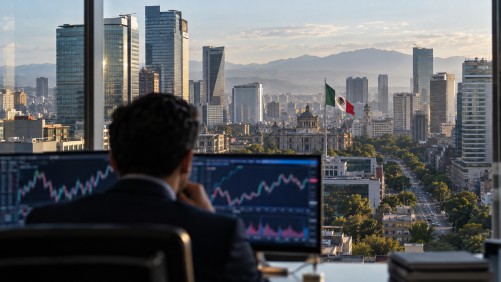
The International Monetary Fund (IMF) has projected growth for Mexico’s economy with a forecasted increase in gross domestic product (GDP) of 1.5% in 2026, followed by a rise to 1.8% in 2027. This outlook is attributed to the country’s sustained export growth and stabilizing investment levels. However, trade-related uncertainties, particularly concerning the United States–Mexico–Canada Agreement (USMCA), are expected to pose challenges to economic activity.
Mexico’s role as a significant exporter of computers and electronic components has bolstered its economic prospects. This growth is partly driven by a robust demand from the United States for data center infrastructure and artificial intelligence (AI) technologies. The country’s manufacturing capacity and established supply chains within North America have reinforced its position as a crucial supplier of technology products.
Despite these positive indicators, the IMF has highlighted potential risks, notably the uncertainty surrounding the renewal of the USMCA. This agreement plays a vital role in maintaining trade stability in the region. The IMF also projects that inflation in Mexico will reach 3.8% by the end of 2026, which exceeds the Bank of Mexico’s target of 3%. Nonetheless, the IMF anticipates that external demand will continue to support the Mexican economy.
The macroeconomic conditions in Mexico remain broadly stable, according to the IMF. While the country faces inflationary pressures, its export-driven growth and strategic position in technology manufacturing contribute positively to its economic outlook. The continuation of strong external demand is expected to play a crucial role in sustaining economic momentum in the coming years.