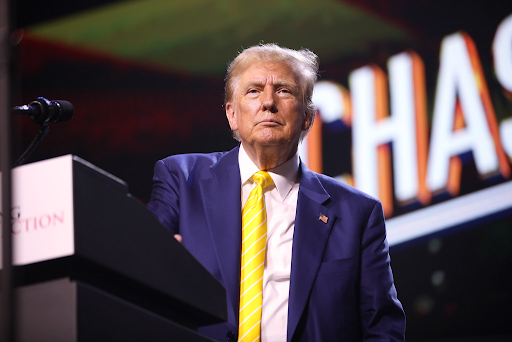
President Trump’s announcement of a 15% global tariff Saturday was more than just a reaction to a Supreme Court setback — it was a signal of intent to reshape US trade law on his own terms, using every legal tool available and vowing to develop a lasting, court-proof tariff framework during the 150-day window the new law provides.
The Supreme Court ruled 6-3 on Friday that Trump’s IEEPA-based tariffs were unlawful without congressional authorization. Trump responded immediately by invoking Section 122 of the Trade Act of 1974, which allows tariffs of up to 15% for 150 days. His administration announced it would use that period to craft new, legally permissible long-term tariffs.
Trump’s rhetoric underscored his broader agenda. He accused foreign nations of “ripping” the US off for decades and framed his tariff strategy as rightful reclamation of American economic power. He called the Supreme Court’s ruling “extraordinarily anti-American” and attacked justices personally, particularly singling out his own nominees as disloyal and unpatriotic.
The international community responded with concern and calls for stability. Germany’s Chancellor Merz said he would bring a coordinated European position to Washington, warning that tariff instability was “poison” for economic planning. France’s Macron defended judicial independence and called for trade reciprocity rather than unilateral actions. The UK faces an uncertain future having previously agreed to a 10% rate.
Business groups warned of growing damage to both the American and global economies. Research shows that roughly 90% of the $130 billion in tariffs already collected has been paid by US businesses and consumers. Exemptions to the new 15% rate include critical minerals, metals, pharmaceuticals, and USMCA-compliant imports from Canada and Mexico.
Trump Raises Tariffs, Threatens Long-Term Overhaul of US Trade Law